Climate tech can’t scale on corporate generosity alone
Microsoft’s reported pull-back from carbon removal and even 2030 clean energy targets proves that the sector needs policy help.
Explore our expert insights and analysis in leading energy and climate news stories.
Microsoft’s reported pull-back from carbon removal and even 2030 clean energy targets proves that the sector needs policy help.
Get the latest as our experts share their insights on global energy policy.
Two economic planning documents released at the March meeting of China's National People’s Congress include the term "energy powerhouse" for the first time.
Hear in-depth conversations with the world’s top energy and climate leaders from government, business, academia, and civil society.
In moments of geopolitical crisis, energy is never just a backdrop. It's often at the center of the story. Today, as conflict involving Iran sends shockwaves through global...
Past Event
February 5, 2019
6:00 pm - 7:30 pm utc
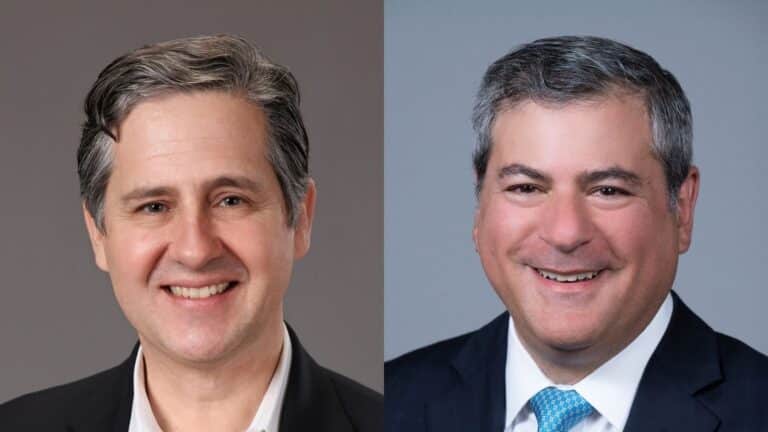
Two years ago Robert McNally, President of Rapidan Energy Group and non-resident fellow at the Center on Global Energy Policy, published Crude Volatility: The History and the Future of Boom-Bust Oil Prices (Columbia University Press, 2017). Crude Volatility, the first in CGEP’s book series and the recipient of Honorable Mention for Economics at the 2018 PROSE Awards, surveyed and evaluated the history of the oil market through the prism of price stability and volatility, studying the factors that contributed to periods of relatively stable and unstable prices. McNally concluded that only during periods in which there was an effective swing producer, willing and able to adjust output to keep prices stable, were oil markets able to avoid the extreme price volatility that harms the oil industry and broader economy. He also asserted that the global oil market had been without a swing producer since 2008, which explained the wide gyration in crude prices in the period. In late 2016, just as Crude Volatility was heading to print, Saudi Arabia and Russia spearheaded a new attempt to manage crude supplies, bringing together 25 OPEC and non-OPEC producers in what is now called “OPEC-Plus.” OPEC-Plus successfully implemented production cuts over the last two years, which some analysts credit with stabilizing prices. Is OPEC-Plus the swing producer the oil market has been looking for? Can we expect more stable prices going forward? And what role are US shale and Washington energy policy playing in global oil stability? To address these and other questions, join the Center on Global Energy Policy for an event with Robert McNally and a distinguished panel of oil experts who will take stock of the analysis in Crude Volatility in light of the events over the last two years. Following McNally’s presentation, he will join Jamie Webster, fellow at the Center on Global Energy Policy and senior director at Boston Consulting Group’s Center for Energy Impact, and Marianne Kah, adjunct senior research scholar at the Center on Global Energy Policy and former chief economist at ConocoPhillips, on a panel moderated by Antoine Halff, senior research scholar at the Center on Global Energy Policy. — Guests unable to attend in person can view a livestream of the event at energypolicy.columbia.edu/livestream. This event is open to press. Please direct media inquiries and interview requests to Artealia Gilliard ([email protected]). For more information contact: [email protected].
On February 28, the United States and Israel launched an attack on Iran, resulting in the deaths of Iranian Supreme Leader Ali Hosseini Khamenei and senior Iranian leaders...


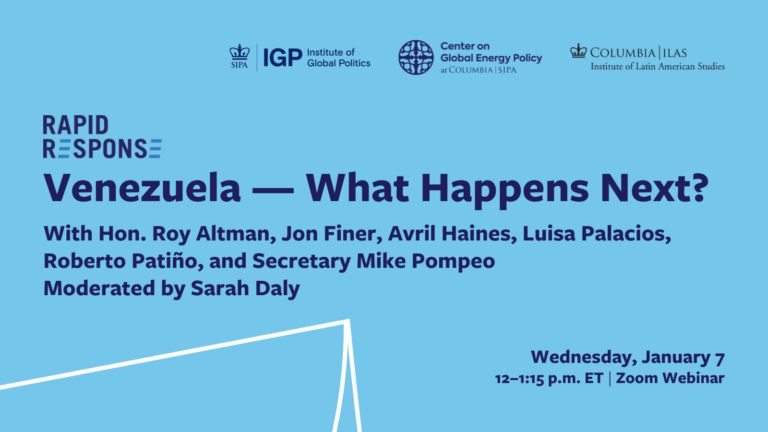
The recent military operation to remove Venezuelan President Nicolás Maduro and First Lady Cilia Flores raises several implications for the future of Venezuela and Latin America, geopolitics, and energy markets. Cosponsored by SIPA’s Institute of Global Politics (IGP) and Center for Global Energy Policy (CGEP), along with Columbia’s Institute of Latin American Studies (ILAS), this webinar will analyze the circumstances and impact of their capture and extradition to New York to face narcoterrorism and drug trafficking charges.
On October 22, the United States Department of the Treasury announced the imposition of sanctions on Russia’s two largest oil companies, Rosneft and Lukoil, as a penalty for what it characterized as a lack of Russian commitment to ending the war in Ukraine.
*Registration is closed for this event. The Center on Global Energy Policy at Columbia University SIPA's Women in Energy initiative, in collaboration with the Columbia Policy Institute, invites...

The White House declared last week that President Trump finally "broke OPEC" after the United Arab Emirates withdrew from the cartel.
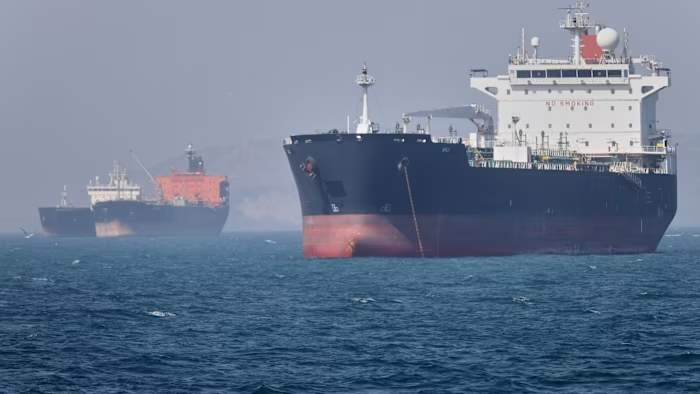
The US blockade of tankers serving Iran's oil exports is intended to cut Iranian oil exports to near-zero.