How Texas plans to serve ‘infinite demand’
Eric Goff, founder of Goff Policy on batch zero, transmission planning, and how Texas can serve new load without shifting costs onto existing customers.
This website uses cookies as well as similar tools and technologies to understand visitors’ experiences. By continuing to use this website, you consent to Columbia University’s usage of cookies and similar technologies, in accordance with the Columbia University Website Cookie Notice.
Our work is committed to independent and nonpartisan research that meets the high standards of academic integrity and quality at Columbia University.
Our initiatives and programs are designed to address critical needs in key focus areas around energy and climate policy.
Explore our expert insights and analysis in leading energy and climate news stories.
Eric Goff, founder of Goff Policy on batch zero, transmission planning, and how Texas can serve new load without shifting costs onto existing customers.
Get the latest as our experts share their insights on global energy policy.
Many analyses of what the conflict in the Middle East means for China's energy security have rightly focused on China's oil and natural gas imports from the region.
Hear in-depth conversations with the world’s top energy and climate leaders from government, business, academia, and civil society.
For years, the energy transition was discussed as a shift that would happen in steady, predictable increments. But the last 24 months have shattered that illusion. Energy providers...
Find out more about our upcoming and past events.
We are the premier hub and policy institution for global energy thought leadership. Energy impacts every element of our lives, and our trusted fact-based research informs the decisions that affect all of us.
Jackie Ratner is former Director of Research Administration at the Center on Global Energy Policy. She draws from her career as a researcher to lead a team of program and project managers in developing processes and procedures that facilitate research at the Center.
Before joining CGEP, Jackie was Senior Project Manager at the National Center for Disaster Preparedness, another think tank at Columbia University. She managed a portfolio of applied research and consulting projects contributing to disaster risk reduction, decision support tools, and business intelligence for clients in industry and government. She has been an American Geophysical Union science policy fellow, a DAT/Artathon data visualization fellow, and international contributor to science outreach and communication initiatives. Drafted under her leadership, the issue brief series for Resilient Children Resilient Communities was recommended as a policy resource to the Biden Presidential transition team. Prior to joining Columbia, she led the non-profit sector in two counties through cooperative long-term disaster recovery after Superstorm Sandy. Earlier research focused on utilizing crowd-sourced structure-from-motion as a solution to volcanic hazard GIS data scarcity in Latin America, undertaken during DPhil studies at the University of Oxford. Her BS with honors in environmental geology was earned at UNC Chapel Hill with a research minor in marine science.
CGEP convened diverse economic stakeholders in a series of five workshops to discuss, under the Chatham House Rule, upcoming revisions to the Greenhouse Gas Protocol led by the World Resources Institute.
As more organizations turn to the GHGP for guidance on tracking their own emissions, they have raised questions as to whether the GHGP in its current form is still fit for that purpose and, if not, how it can be updated.
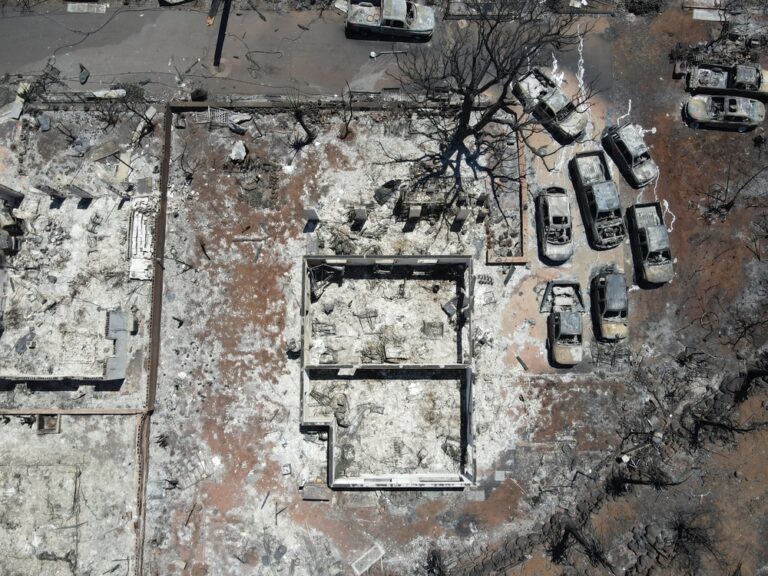
This summer's wildfires on Maui are the largest environmental disaster in Hawaiian history.
Get the latest news and research on energy & climate policy.
"(required)" indicates required fields